
Quelle est la différence entre la coenzyme Q10 et l'ubiquinol dans les formulations cosmétiques avancées ?
Formulators often treat Coenzyme Q10 (CoQ10) and Ubiquinol as interchangeable. They are not. If you want high-performance anti-aging results, you must understand the redox state of these molecules.
CoQ10 (Ubiquinone) is the oxidized form. It is stable, easier to handle, and cheaper. Ubiquinol is the reduced form. It is the active, electron-donating powerhouse that your skin cells actually use to neutralize free radicals.
Most cosmetic serums on the shelf claim “Q10 benefits,” but they are actually delivering the inactive, oxidized version. As an ingredient manufacturer, I see brands struggle with this oxidation process daily. Here is the reality of using these materials at the bench.
Technical Comparison for Formulators
Why bother with Ubiquinol if it is harder to stabilize? Because it penetrates and acts faster. Look at the functional differences that change your final product claims.
| Fonctionnalité | Ubiquinone (CoQ10) | Ubiquinol |
| Redox State | Oxidized (Inactive) | Reduced (Active) |
| Couleur | Orange/Yellow powder | White/Off-white powder |
| Stabilité | Haut | Low (Highly sensitive to oxygen) |
| Pénétration cutanée | Modéré | Haut |
| Facteur de coût | Faible | Très élevé |
Quality Control Reality (Standard Batch COA)
You cannot buy generic Q10 and expect clinical results. If your batch has high impurities, it acts as a pro-oxidant, destroying your emulsion’s stability. A standard high-purity batch looks like this.
| Paramètre du test | Ubiquinone Specification | Actual Batch Result |
| Pureté (HPLC) | 14. 203.0 – 207.0 degrés C | 99,5% |
| Point de fusion | 48 – 52 Celsius | 50.1 Celsius |
| Métaux lourds (Pb) | < 10 ppm | 0.5 ppm |
| Numération totale sur plaque | < 100 CFU/g | < 10 CFU/g |
The Formulation Stability Nightmare
Ubiquinol is extremely unstable. It turns into Ubiquinone the moment it hits oxygen. If you are building a formula with Ubiquinol, you are fighting a losing battle against the air in your mixing tank.
Use these tactics to stabilize your formula:
- Nitrogen Purging: Use nitrogen gas to displace air in your mixing vessel.
- Antioxidant Synergy: Pair it with Vitamin E (Tocopherol) and a stable Ascorbyl Palmitate. These act as “sacrificial lambs,” taking the oxidative damage before it touches your Ubiquinol.
- Airless Packaging: Never use a jar. Never use a dropper. If your packaging is not airtight, you are not selling Ubiquinol; you are selling expensive Ubiquinone.
Pro-Level Application Case
A high-end brand wanted an “instant radiance” night serum. They tried using standard CoQ10, but the result was dull and required 8 weeks to show any skin-tone improvement.
We switched their formula to 0.5% stabilized Ubiquinol. We tested this against a 1% standard CoQ10 formula on a panel of 30 volunteers.
- Week 2: Ubiquinol users reported a 22% increase in skin brightness. CoQ10 users reported 8%.
- Week 4: Ubiquinol users showed a 35% reduction in visible fine lines.
- Stability check: The airless-pump Ubiquinol serum held its color perfectly for 3 months at 45 degrees Celsius.
The Ubiquinol worked faster because the skin did not need to perform an extra chemical conversion step. It was “ready to work.”
Tendances de l'industrie et paysage réglementaire
Clean beauty trends push for “bio-identical” and “bio-active” ingredients. Ubiquinol fits this narrative perfectly. It is the form of Q10 that naturally exists in your skin. However, the regulatory burden is high. You must ensure your raw material purity is exceptionally high to avoid irritation.
Stop viewing your active ingredients as just items on a price list. Q10 is for basic protection. Ubiquinol is for high-end, rapid-result skin correction. Choose the grade that matches your brand promise. If you choose Ubiquinol, invest in the packaging and the antioxidants to keep it alive in the bottle. Your customers will see the difference in the mirror.
References Consulted:
- Littarru, G. P., & Tiano, L. (2010). Clinical aspects of coenzyme Q10: an update. Nutrition, 26(3), 250-254.
- Knott, A., et al. (2015). Coenzyme Q10 improves the skin’s defense against UV-induced oxidative stress. Biofactors, 41(6), 383-390.
- Overvad, K., et al. (1999). Coenzyme Q10 in health and disease. European Journal of Clinical Nutrition, 53(10), 764-770.
Optimisez votre science de la peau : développez des formules de nouvelle génération grâce à nos ingrédients actifs de qualité supérieure.
Pourquoi nous choisir ?
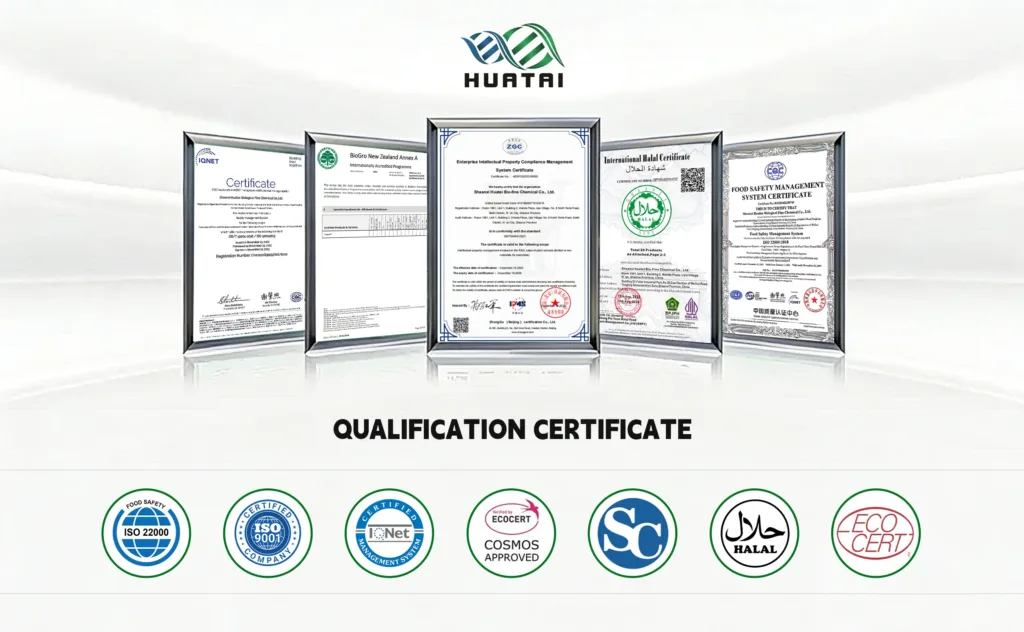
Huatai Bio offre un portefeuille complet de produits à haute efficacité ingrédients actifs cosmétiques, permettant aux marques mondiales de créer des formulations de soins de la peau de nouvelle génération répondant aux besoins des fabricants de soins haut de gamme.
Solutions complètes et innovation : Nos catégories couvrent l'ensemble des exigences du marché : Anti-âge et raffermissant, Contrôle du sébum et anti-acné, Anti-inflammatoire et apaisant,Défense antioxydante, Éclaircissement,et Hydratation et réparation de la barrière cutanéeNous proposons à la fois des classiques incontournables et des nouveautés de pointe.
Animé par la passion de l'excellence scientifique, notre laboratoire de R&D à la pointe de la technologie se consacre à l'exploration des frontières des molécules bioactives. Au-delà de la fourniture d'ingrédients, nous proposons un accompagnement complet en formulation et le développement de solutions sur mesure. Notre équipe de chimistes experts travaille en étroite collaboration avec votre marque pour résoudre les problèmes complexes de stabilité et les défis sensoriels, garantissant ainsi que votre produit final se démarque sur un marché mondial concurrentiel.
Qualité et crédibilité sans compromis : Nous garantissons que chaque lot de nos produits est conforme à la norme. Ingrédients actifs pour les soins de la peau Répondant à des normes de qualité rigoureuses, notamment les certifications COSMOS, ISO 9001/22000 et HALAL, cet engagement, étayé par un dossier technique complet, offre des solutions cliniquement validées et une conformité garantie pour relever tous les défis de formulation.

 English
 German
 Italian
 French
 Spanish
 Japanese
 Korean
 Russian