Quels sont les bienfaits cosmétiques et les avantages de formulation de l'alpha-arbutine dans les soins de la peau ?
Alpha-Arbutin: Technical Insights and Formulation Optimization in Modern Skincare
Alpha-Arbutin (4-hydroxyphenyl-alpha-D-glucopyranoside) remains a cornerstone in melanin-inhibiting research. Unlike its beta-isomer, the alpha-glycosidic bond provides significantly higher stability and affinity for tyrosinase, the rate-limiting enzyme in melanogenesis.
For formulators, the challenge is not just efficacy, but the structural integrity of the molecule during the manufacturing process.
Chemical Profile and Stability
Alpha-Arbutin functions through competitive inhibition. It mimics the structure of tyrosine, blocking the active site of tyrosinase without causing the cytotoxicity associated with hydroquinone.
| Paramètre | Détails techniques |
| Apparence | Poudre cristalline blanche |
| Solubilité | Très soluble dans l'eau |
| Pureté | ≥ 99,0% |
| Point de fusion | 203°C – 207°C |
| Rotation spécifique | +175° to +185° |
| pH Range (Stability) | 3,5 – 6,5 |
The primary risk in formulation is hydrolysis. In a low-pH environment or at high temperatures, the alpha-glycosidic bond can break, releasing hydroquinone. This is why strict temperature control during the cooling phase—typically below 40°C—is non-negotiable.
Formulation Blueprint: Beyond Standard Emulsions
Most formulators treat Alpha-Arbutin as a “drop-in” ingredient. This often leads to poor penetration or premature degradation. To maximize delivery, we look at the interaction with the lipid barrier.
Recommended Formulation Strategy:
- Phase A (Aqueous): Dissolve Alpha-Arbutin in deionized water at room temperature. Do not heat this phase alongside the oil phase.
- Phase B (Stabilization): Incorporate chelating agents (e.g., Disodium EDTA) to sequester trace metal ions that can catalyze the oxidation of arbutin derivatives.
- Phase C (Emulsification): Once the emulsion is formed and cooled below 40°C, introduce the active phase.
Case Study: Synergy with Antioxidants
We observed that when pairing Alpha-Arbutin (2%) with L-Ascorbic Acid (5%), the stability profile of the formula drops if pH is not strictly buffered at 5.0. However, swapping L-Ascorbic acid for a more stable derivative like Sodium Ascorbyl Phosphate allows the formula to maintain a pH of 6.0, significantly extending the shelf life of the Alpha-Arbutin while maintaining synergistic brightening effects.
Efficacy Data and Comparative Analysis
Why prioritize Alpha-Arbutin over other tyrosinase inhibitors? The following data highlights the comparative inhibition efficiency based on public enzyme-assay standards.
| Ingrédient | IC50 (µmol/L) | Mechanism Focus |
| Alpha-arbutine | 0.48 | Tyrosinase inhibition |
| Bêta-arbutine | 2.50 | Tyrosinase inhibition |
| Hydroquinone | 0.05 | Cytotoxic suppression |
| Acide kojique | 0.60 | Copper chelation |
Note: A lower IC50 indicates higher potency in inhibiting enzyme activity.
The data shows that Alpha-Arbutin is significantly more potent than the beta-isomer. While hydroquinone is technically more “potent,” its safety profile limits its use in over-the-counter formulations. Alpha-Arbutin bridges this gap between efficacy and safety.
Industry Compliance and Quality Control
When sourcing or manufacturing, the Certificate of Analysis (COA) must be scrutinized beyond the purity percentage. Two critical metrics often overlooked are:
- Residual Hydroquinone: Must be strictly limited to <10 ppm to ensure safety and prevent irritation.
- Métaux lourds : Total heavy metals should be <10 ppm.
Formulators must also verify the absence of enzymatic contamination. If the raw material is exposed to arbutase (an enzyme that can degrade arbutin), the stability of the final product will be compromised regardless of the manufacturing technique.
Practical Troubleshooting
- Issue: Product turns yellow over time.
- Root Cause: Often due to pH fluctuations above 7.0 or exposure to high heat during processing.
- Fix: Ensure the buffering system is robust. Check for ingredient incompatibility with iron salts.
- Issue: Crystal formation in serum.
- Root Cause: Over-saturation or temperature shock.
- Fix: Adjust the glycol levels (Propanediol or Butylene Glycol) to improve solubility at lower temperatures.
Références
- Boissy, R. E., et al. (Journal of Investigative Dermatology): Studies on the comparative inhibition of tyrosinase by glycosylated hydroquinones.
- Sugimoto, K., et al. (Biological and Pharmaceutical Bulletin): Evaluation of the inhibitory effects of arbutin on melanin synthesis.
- International Journal of Toxicology: Safety assessment of alpha-arbutin in cosmetic products.
Optimisez votre science de la peau : développez des formules de nouvelle génération grâce à nos ingrédients actifs de qualité supérieure.
Pourquoi nous choisir ?
Huatai Bio offre un portefeuille complet de produits à haute efficacité ingrédients actifs cosmétiques, permettant aux marques mondiales de créer des formulations de soins de la peau de nouvelle génération répondant aux besoins des fabricants de soins haut de gamme.
Solutions complètes et innovation : Nos catégories couvrent l'ensemble des exigences du marché : Anti-âge et raffermissant, Contrôle du sébum et anti-acné, Anti-inflammatoire et apaisant,Défense antioxydante, Éclaircissement,et Hydratation et réparation de la barrière cutanéeNous proposons à la fois des classiques incontournables et des nouveautés de pointe.
Animé par la passion de l'excellence scientifique, notre laboratoire de R&D à la pointe de la technologie se consacre à l'exploration des frontières des molécules bioactives. Au-delà de la fourniture d'ingrédients, nous proposons un accompagnement complet en formulation et le développement de solutions sur mesure. Notre équipe de chimistes experts travaille en étroite collaboration avec votre marque pour résoudre les problèmes complexes de stabilité et les défis sensoriels, garantissant ainsi que votre produit final se démarque sur un marché mondial concurrentiel.
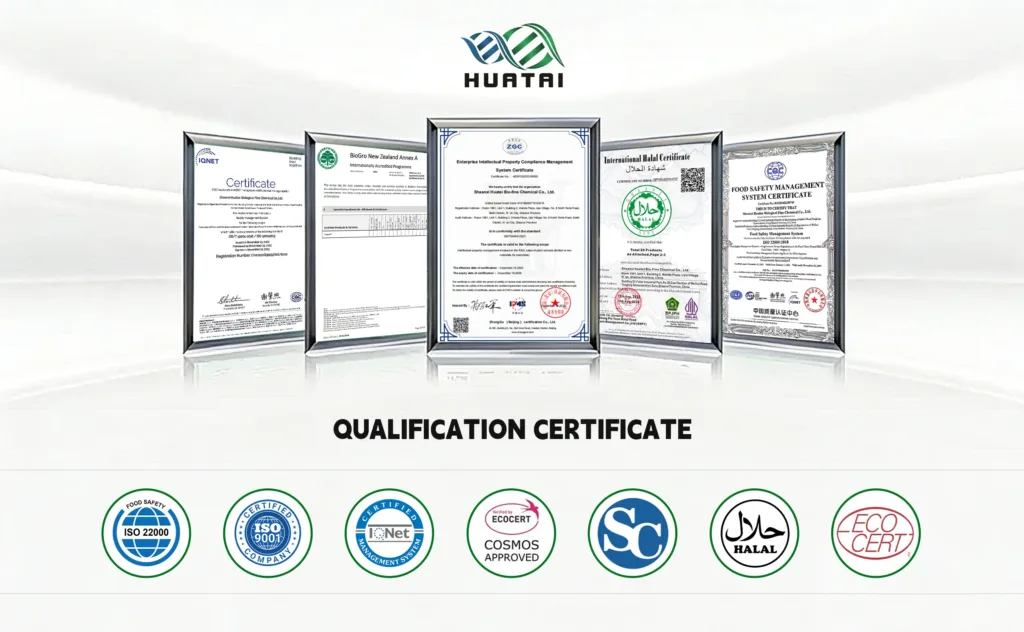
Qualité et crédibilité sans compromis : Nous garantissons que chaque lot de nos produits est conforme à la norme. Ingrédients actifs pour les soins de la peau Répondant à des normes de qualité rigoureuses, notamment les certifications COSMOS, ISO 9001/22000 et HALAL, cet engagement, étayé par un dossier technique complet, offre des solutions cliniquement validées et une conformité garantie pour relever tous les défis de formulation.


 English
 German
 Italian
 French
 Spanish
 Japanese
 Korean
 Russian