
Maîtriser la stabilité de la formulation avec le dipalmitate de kojique pour un éclaircissement cutané avancé
Formulating Beyond the Browning Effect: A Technical Guide to High-Purity Kojic Dipalmitate
Have you ever pulled a stability sample out of the incubator at 45 degrees Celsius only to find your pristine white cream looks like muddy water? We see this constantly. Formulators love the idea of brightening acids, but hate the reality of working with them on the production floor.
Let us skip the standard pitch. As active ingredient manufacturers, we know the raw truth about stability. Free Kojic Acid oxidizes rapidly. It chelates with trace iron in your mixing tanks. It breaks down under UV light. You end up over-dosing the active and stuffing the formula with expensive antioxidants just to keep it looking decent on the shelf. You are not formulating at that point. You are running a rescue mission.
You fix this by changing the molecule. We attach palmitic acid to the vulnerable hydroxyl groups. You lose the water solubility, but you gain a virtually indestructible ester: Kojic Dipalmitate.
The Formulation Data Reality Check
Purity and molecular structure dictate performance. We isolated the exact formulation impacts of using the esterified derivative versus the standard acid.
| Paramètre | Free Kojic Acid | Dipalmitate de kojique | Impact de la formulation |
| Stability Profile | Poor (Rapid Oxidation) | Excellent | Stops product discoloration and degradation |
| Solubilité | Water Phase | Oil Phase | Bypasses the lipid barrier for deep penetration |
| Tolérance au pH | Narrow (Highly Acidic) | Broad (3.0 – 10.0) | Allows formulation in neutral creams or soap bars |
| Potentiel d'irritation | Haut | Très faible | Safe for sensitive skin barrier repair formulations |
A Real-World Emulsion Crisis
Let us look at a concrete case from our technical application lab. A mid-tier dermo-cosmetic brand approached us last year. Their brightening night balm was failing stability testing within eight weeks. The emulsion split slightly, but worse, the color shifted from pale cream to dark yellow. They were using a 2% water-soluble active and struggling to keep it viable.
We switched their active to our high-purity Kojic Dipalmitate. We audited their processing protocol. The fix was straightforward. Add the powder directly into the lipid phase. Heat the oil phase to 75 to 80 degrees Celsius to ensure complete dissolution before emulsification.
Why does this work better biologically? The skin is a lipid shield. Water-soluble actives sit on the surface. Melanin production happens deep in the epidermis. Because the ester loves oil, it penetrates the skin barrier effortlessly, delivering the tyrosinase inhibitor exactly where the melanocytes live. The brand achieved a flawless 24-month stability profile. No color shift. No irritation complaints.
Synergistic Formulation Blueprints
Kojic Dipalmitate operates brilliantly alone at a 1% to 5% dosage. However, we see the best market successes when formulators use it to amplify other actives in the oil phase.
- Dual-Action Lipid Brightening: Combine 2% Kojic Dipalmitate with 1% Ascorbyl Tetraisopalmitate (Oil-Soluble Vitamin C). You attack pigmentation from two angles. You stop the tyrosinase enzyme, and the Vitamin C reduces existing oxidized melanin. They share the exact same lipid phase perfectly.
- Anti-Inflammatory Pigment Correction: Pair it with Glabridin. Glabridin kills the background inflammation caused by UV rays. You fade the dark spot while stopping the post-inflammatory hyperpigmentation cycle.
- Barrier Safe Systems: Add Ceramides to the oil phase. Many whitening agents strip the skin. Mixing Ceramides with the ester keeps the skin barrier intact. You reduce irritation and improve overall skin texture.
Decoding the COA for Production Safety
A Certificate of Analysis is your frontline defense against failed batches. Do not just glance at the appearance. You must audit specific markers. Lesser grades of Kojic derivatives suffer from chelation-induced color changes if they contain high trace metals.
| Critical COA Parameter | Required Specification | Why It Matters |
| Dosage (HPLC) | 98.0% Minimum | Ensures consistent tyrosinase inhibition and clinical efficacy |
| Métaux lourds (Pb, As) | Moins de 10 ppm | Prevents chelation with processing equipment and color shifts |
| Point de fusion | 92 – 96 Degrees Celsius | Confirms pure esterification without cheap lipid fillers |
| Apparence | White or near-white powder | Guarantees the aesthetic appeal of the final cosmetic base |
From a cost standpoint, formulators often hesitate because the raw ester costs more per kilo than the free acid. Look at your actual cost-in-use. You stop buying excess active to cover degradation. You eliminate complex antioxidant systems. You stop dealing with product recalls due to brown creams.
We encourage you to run the stability tests yourself. We supply technical samples to R&D laboratories because we know bench testing is the only way to prove efficacy. Dissolve it in your oil phase. Throw the emulsion in the incubator. See the stability firsthand.
Public Literature References:
- Lajis, A. F. B., et al. (2012). “Kojic acid applications in cosmetic and pharmaceutical preparations.” Journal of Biomedicine and Biotechnology, 2012.
- Draelos, Z. D. (2007). “Skin lightening preparations and the hydroquinone controversy.” Dermatologic Therapy, 20(5), 308-313.
- Sarkar, R., et al. (2013). “Cosmeceuticals for hyperpigmentation: What is available?” Journal de chirurgie cutanée et esthétique, 6(1), 4-11.
Optimisez votre science de la peau : développez des formules de nouvelle génération grâce à nos ingrédients actifs de qualité supérieure.
Pourquoi nous choisir ?
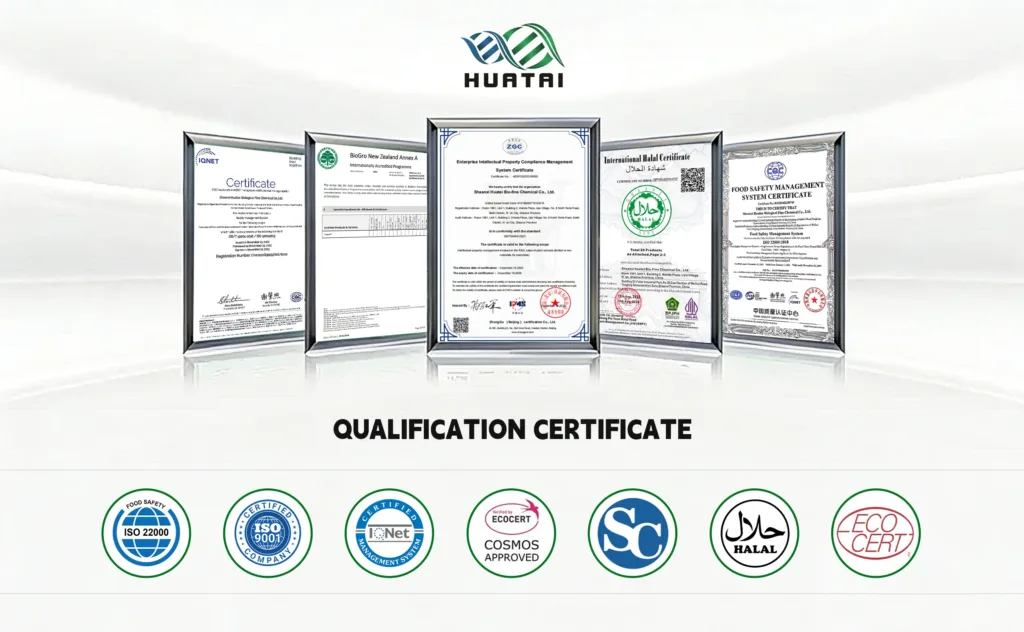
Huatai Bio offre un portefeuille complet de produits à haute efficacité ingrédients actifs cosmétiques, permettant aux marques mondiales de créer des formulations de soins de la peau de nouvelle génération répondant aux besoins des fabricants de soins haut de gamme.
Solutions complètes et innovation : Nos catégories couvrent l'ensemble des exigences du marché : Anti-âge et raffermissant, Contrôle du sébum et anti-acné, Anti-inflammatoire et apaisant,Défense antioxydante, Éclaircissement,et Hydratation et réparation de la barrière cutanéeNous proposons à la fois des classiques incontournables et des nouveautés de pointe.
Animé par la passion de l'excellence scientifique, notre laboratoire de R&D à la pointe de la technologie se consacre à l'exploration des frontières des molécules bioactives. Au-delà de la fourniture d'ingrédients, nous proposons un accompagnement complet en formulation et le développement de solutions sur mesure. Notre équipe de chimistes experts travaille en étroite collaboration avec votre marque pour résoudre les problèmes complexes de stabilité et les défis sensoriels, garantissant ainsi que votre produit final se démarque sur un marché mondial concurrentiel.
Qualité et crédibilité sans compromis : Nous garantissons que chaque lot de nos produits est conforme à la norme. Ingrédients actifs pour les soins de la peau Répondant à des normes de qualité rigoureuses, notamment les certifications COSMOS, ISO 9001/22000 et HALAL, cet engagement, étayé par un dossier technique complet, offre des solutions cliniquement validées et une conformité garantie pour relever tous les défis de formulation.


 English
 German
 Italian
 French
 Spanish
 Japanese
 Korean
 Russian