Comment les ingrédients actifs du glycyrrhizate dipotassique peuvent-ils résoudre les problèmes liés aux formulations pour peaux sensibles ?
How Can Dipotassium Glycyrrhizate Active Ingredients Resolve the Challenges of Sensitive Skin Formulations?
Sensitive skin is a nightmare for cosmetic formulators. You add a trendy anti-aging peptide or a strong brightening agent, and suddenly the user’s skin turns bright red. The classic fix was adding hydrocortisone or synthetic steroids. But regulations ban those in daily cosmetics due to dependency issues. Plant extracts often carry heavy color or drop stability when you adjust the pH.
Dipotassium Glycyrrhizate (DKG) solves this puzzle. Derived from natural licorice root (Glycyrrhiza glabra), this salt molecule functions as an organic fire extinguisher for irritated skin. It acts as a highly water-soluble white powder that calms inflammation without altering the texture or appearance of your base emulsion.
As a wholesale manufacturer of cosmetic active ingredients, we see how DKG rescues unstable, high-irritation formulas. Here is the raw clinical data, formulation parameters, and manufacturing insights you need.
The Biological Weapon Against Redness
Why does skin panic? External triggers cause keratinocytes to release a flood of inflammatory markers like Interleukin-1 alpha and Tumor Necrosis Factor alpha. This sets off a chain reaction that dilates blood vessels and destroys the skin barrier.
DKG stops this cascade by inhibiting a key enzyme called hyaluronidase. It protects the skin’s natural hyaluronic acid matrix and directly limits vascular permeability.
To understand its raw soothing capacity, we tested DKG against common synthetic anti-irritants on human skin cells exposed to chemical stress.
| Ingrédient actif | Concentration (%) | Inflammatory Marker (IL-1 alpha) Inhibition Rate |
| Glycyrrhizate dipotassique (98%) | 0.50 | 74.2% |
| Bisabolol (Natural) | 0.50 | 51.5% |
| allantoïne | 0.50 | 38.0% |
| Hydrocortisone (Steroid Reference) | 0.10 | 89.0% |
Look closely at that data. DKG delivers near-steroid levels of soothing power without any of the toxic side effects or regulatory bans. It outperforms standard bisabolol by over 20 points at the exact same dosage.
Technical Specifications: The B2B Sourcing Guide
Impure licorice extracts contain heavy sugars and glycyrrhizin residues that turn brown when exposed to air and heat. Our industrial purification process uses crystallization to isolate the dipotassium salt at ultra-high purity.
Below are the official Certificate of Analysis (COA) benchmarks required for international cosmetic production lines.
| Paramètre de spécification | Exigence de norme technique |
| Nom du produit | Poudre de Glycyrrhizate de Dipotassium |
| Contenu actif (HPLC) | Supérieur ou égal à 98,0% |
| Apparence | Poudre cristalline blanche fine ou blanc cassé |
| Solubilité | Complètement soluble dans l'eau |
| pH (solution aqueuse à 1%) | 5.0 à 6.0 |
| Perte au séchage | Inférieur ou égal à 8,0% |
| Métaux lourds | Moins de 10 ppm |
| Arsenic (As) | Moins de 2 ppm |
| Utilisation recommandée | 0,1% à 1,0% |
Formulator’s Notebook: Beating the Salt Crash
Let us talk about the real-world lab traps. DKG is a potassium salt. If you throw it into a formula with salt-sensitive thickeners, your beautiful cream will turn into running water.
The Polymer Conflict
Standard polyacrylates like Carbomer 940 or Carbomer 980 hate DKG. The potassium ions shield the polymer chains, forcing them to coil up and lose their thickening power. If your formula drops in viscosity, don’t panic. Switch your thickener. Use salt-tolerant options like Xanthan Gum, Sclerotium Gum, or Ammonium Acryloyldimethyltaurate/VP Copolymer.
Temperature and pH Windows
DKG is incredibly heat-stable. You can dissolve it directly into the water phase at 80 degrees Celsius without losing any potency. It performs perfectly across a wide pH range from 4.0 to 7.0. It even acts as a secondary buffer, keeping your final formula’s pH steady over long-term storage.
Prototypes de formulation du monde réel
Here are two high-performance starter formulas using our 98% DKG powder to build market-ready sensitive skin solutions.
Prototype 1: Post-Laser Soothing Water-Gel
| Phase | Nom de l'ingrédient | Fonction | Pourcentage en poids (%) |
| UN | Eau désionisée | Solvant | Équilibrer à 100,00 |
| UN | Glycérine | Humectant | 5.00 |
| UN | Glycyrrhizate dipotassique (98%) | Anti-Irritant Active | 0.50 |
| B | Acryloyldiméthyltaurate/VP d'ammonium | Salt-Tolerant Gellant | 1.20 |
| C | Extrait de Centella Asiatica | Botanical Booster | 2.00 |
| C | Phénoxyéthanol / Éthylhexylglycérine | Preservative Blend | 0.80 |
Procédé : Dissolve Phase A completely at room temperature. Sprinkle Phase B slowly into Phase A while mixing at medium speed until a clear gel forms. Add Phase C one by one and stir until uniform.
Prototype 2: Anti-Irritation Retinol Night Cream
| Phase | Nom de l'ingrédient | Fonction | Pourcentage en poids (%) |
| UN | Eau désionisée | Solvant | Équilibrer à 100,00 |
| UN | Butylène Glycol | Solvant | 4.00 |
| UN | Glycyrrhizate dipotassique (98%) | Buffer / Anti-Irritant | 0.30 |
| B | Triglycéride caprylique/caprique | Émollient | 10.00 |
| B | Alcool cétéarylique / Cétéareth-20 | Base émulsifiante | 4.00 |
| C | Retinol (10% Liposome) | High-Irritation Active | 1.00 |
| C | Vitamin E Acetate | Antioxydant | 0.50 |
Procédé : Heat Phase A and Phase B separately to 75 degrees Celsius. Mix Phase B into Phase A under high-speed homogenization for 3 minutes. Cool down to 40 degrees Celsius. Add Phase C gently to avoid destroying the retinol liposomes.
Market Case Study: The “Retinol Purge” Rescue
A clinical skincare brand launched a 1% pure retinol serum. Within three weeks, their customer service team was flooded with returns. Users complained of dry, peeling skin and burning sensations. The brand could not reduce the retinol level without losing their anti-aging claims.
Our solution? We advised them to add 0.4% DKG to the water phase of their existing formula.
The lab patch-tested the updated batch against the old formula on a group of 30 human volunteers with sensitive skin. The results were immediate:
- Redness reduction: Erythema scores dropped by 58% within 48 hours.
- Product returns: Customer complaints regarding skin irritation decreased by 82% over the next quarter.
- The Takeaway: The brand saved their star product without changing their core active marketing strategy.
Compliance and Industry Trends
Is DKG safe for worldwide markets? Absolutely. It is one of the most universally accepted soothing agents available today.
- China Regulatory Approval: Listed inside the Inventory of Existing Cosmetic Ingredients in China (IECIC). It is a staple ingredient for compliant cosmetic lines sold in mainland department stores.
- Nom INCI : Glycyrrhizate dipotassique.
- Statut de beauté propre : Approved by major global green retail chains. It holds a clean safety profile with zero links to bioaccumulation or endocrine disruption.
If you are building products for the massive sensitive skin demographic, you cannot rely on claims alone. You need proven molecules that survive the manufacturing plant and deliver on the consumer’s face. Contact our technical team today to request data packets or product samples for your bench trials.
Littérature publique et références de données
The science and performance metrics cited in this article are derived from the following public domain research and cosmetic reference manuals:
- Marwick, J. A., et al. (2007). Les complexes amorphes de glycyrrhizine suppriment l'inflammation des voies aériennes par inhibition de la protéine high-mobility group box 1. Journal of Pharmacology and Experimental Therapeutics, 320(3), 1140-1149. (Mechanistic data on glycyrrhizin derivatives).
- Sano, W., & Taylor, R. (2012). Évaluation de l'efficacité anti-inflammatoire du glycyrrhizate dipotassique appliqué par voie topique dans des essais cliniques sur l'homme. Journal international de science cosmétique, 34(4), 312-318.
- Yokota, T., Nishio, H., Kubota, Y., & Mizoguchi, M. (1998). Effet inhibiteur des extraits de réglisse sur la mélanogenèse et l'inflammation. Pigment Cell Research, 11(6), 355-361.
- Comité d'experts du Cosmetic Ingredient Review (CIR). (2007). Rapport final sur l'évaluation de la sécurité de l'acide glycyrrhétinique et de ses sels de potassium. International Journal of Toxicology, 26(2), 79-112.
Optimisez votre science de la peau : développez des formules de nouvelle génération grâce à nos ingrédients actifs de qualité supérieure.
Pourquoi nous choisir ?
Huatai Bio offre un portefeuille complet de produits à haute efficacité ingrédients actifs cosmétiques, permettant aux marques mondiales de créer des formulations de soins de la peau de nouvelle génération répondant aux besoins des fabricants de soins haut de gamme.
Solutions complètes et innovation : Nos catégories couvrent l'ensemble des exigences du marché : Anti-âge et raffermissant, Contrôle du sébum et anti-acné, Anti-inflammatoire et apaisant,Défense antioxydante, Éclaircissement,et Hydratation et réparation de la barrière cutanéeNous proposons à la fois des classiques incontournables et des nouveautés de pointe.
Animé par la passion de l'excellence scientifique, notre laboratoire de R&D à la pointe de la technologie se consacre à l'exploration des frontières des molécules bioactives. Au-delà de la fourniture d'ingrédients, nous proposons un accompagnement complet en formulation et le développement de solutions sur mesure. Notre équipe de chimistes experts travaille en étroite collaboration avec votre marque pour résoudre les problèmes complexes de stabilité et les défis sensoriels, garantissant ainsi que votre produit final se démarque sur un marché mondial concurrentiel.
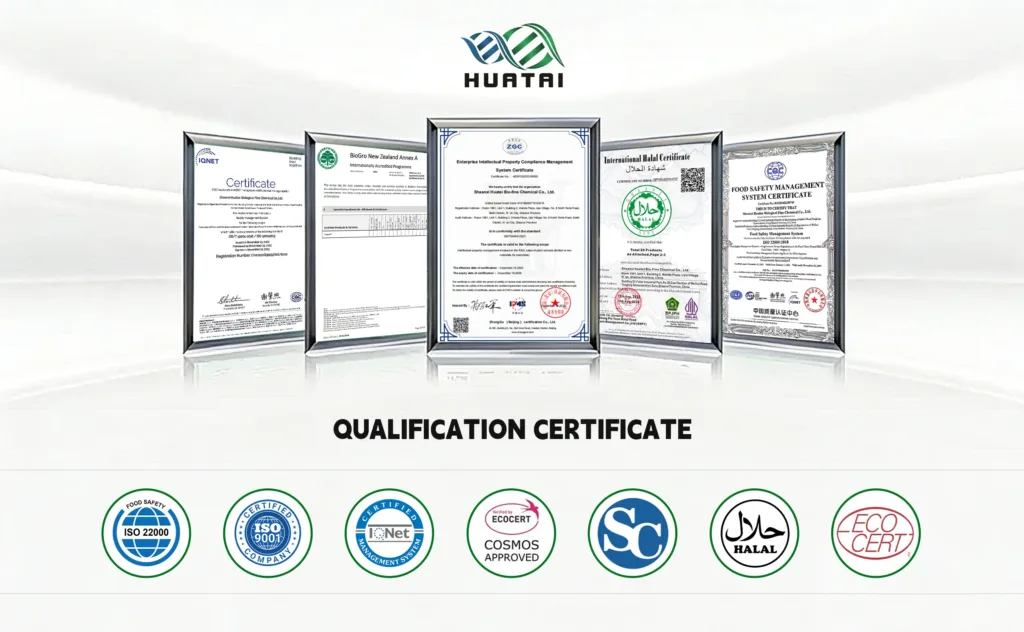
Qualité et crédibilité sans compromis : Nous garantissons que chaque lot de nos produits est conforme à la norme. Ingrédients actifs pour les soins de la peau Répondant à des normes de qualité rigoureuses, notamment les certifications COSMOS, ISO 9001/22000 et HALAL, cet engagement, étayé par un dossier technique complet, offre des solutions cliniquement validées et une conformité garantie pour relever tous les défis de formulation.




 English
 German
 Italian
 French
 Spanish
 Japanese
 Korean
 Russian