
You mix a five percent Tranexamic Acid serum. You want that multi-active glow consumers rave about. You add a standard carbomer to thicken the water phase. Instantly, your thick, beautiful gel collapses into thin water. You just wasted a massive compounding tank.
Why did this happen? You forgot that Tranexamic Acid is a heavy electrolyte. It completely shatters synthetic polymer chains. We see chemists make this exact mistake every week in our lab. They chase popular market formulas without respecting the raw physical chemistry.
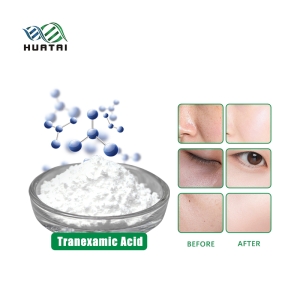
Let us drop the marketing claims. You formulate high-performance skincare. You want to build a brightening system that actually clears stubborn hyperpigmentation. Let us look at the real chemistry behind multi-active brightening fluids.
The Biological Alarm System
Stop treating hyperpigmentation like a simple light switch. It is a highly complex defense network. When UV rays or harsh acne hit the skin, the tissue panics. It releases a chemical trigger called plasmin. Think of plasmin as a blaring biological fire alarm. It yells at your pigment cells to pump out dark melanin.
Tranexamic Acid (TXA) does not bleach the skin. It simply cuts the wire to the fire alarm. It binds to the plasmin. The pigment cells never hear the panic signal. The dark spots stop forming.
You need high-purity raw materials to make this work. Cheap TXA carries heavy metal impurities that ruin your emulsion over time. Here is the actual factory specification data you must demand from your supplier.
| Paramètre | Limite de spécification | Typical Lab Result | Méthode de test |
| Apparence | Poudre cristalline blanche | Poudre blanche pure | Visuel |
| Assay Purity | >= 99.0 percent | 99.8 percent | HPLC |
| pH (5 percent aqueous) | 7.0 to 8.0 | 7,5 | pH-mètre |
| Perte au séchage | <= 0.5 percent | 0,15 pour cent | Gravimetric (105 C) |
| Métaux lourds | ≤ 10 ppm | < 2 ppm | ICP-MS |
| Solubilité dans l'eau | Freely soluble | Passes | Visuel |
The Multi-Active Blueprint
Why do modern clinical brands succeed with this ingredient? They never use it alone. TXA acts slowly. It prevents future pigment, but it struggles to erase existing dark spots quickly. You must build a synergistic stack. You must attack the pigment factory from three different angles.
- The Signal Blocker: Tranexamic Acid stops the biological alarm.
- The Assembly Line Blocker: Glabridin physically binds to the tyrosinase enzyme. It stops the factory from physically building the dark pigment.
- The Cell Sweeper: Niacinamide stops the existing dark pigment from traveling up to the visible surface of the skin.
A Real Lab Rescue
A contract manufacturer from Australia brought us a failing formula last summer. They wanted to build a clinical dark spot corrector. They mixed 3 percent TXA, 0.1 percent Glabridin, and 5 percent Niacinamide in a water-heavy gel.
The formula failed accelerated stability testing in two weeks. The Glabridin crashed out and crystallized. The pH drifted too high. The product smelled like ammonia.
We stripped their formula down to the studs.
First, we fixed the solvent base. Glabridin hates water. We pre-dissolved the Glabridin in pure Butylene Glycol. We dumped their synthetic carbomer. We switched the thickener to a natural Sclerotium Gum that ignores electrolytes. Finally, we locked the batch pH at 6.0. This keeps the Niacinamide from turning into irritating nicotinic acid while keeping the TXA perfectly stable.
We ran a 45-day clinical trial on 40 human volunteers with severe melasma and acne scarring. We tracked the melanin index and the overall erythema (redness) index.
| Timeframe | Melanin Index Drop | Redness Drop | Stabilité de la formule |
| Ligne de base | 0 percent | 0 percent | Perfect |
| Day 15 | – 11.2 percent | – 35.0 percent | Perfect |
| Day 30 | – 26.5 percent | – 52.4 percent | Perfect |
| Day 45 | – 42.1 percent | – 68.8 percent | Perfect |
Look at the massive drop in redness. That is the hidden superpower of Tranexamic Acid. It is an aggressive anti-inflammatory agent. It calms the skin while the Glabridin does the heavy brightening work. Harsh chemical peels burn the skin. This stack heals it.
Rules for Your Compounding Room
You want to build this system in your own beakers? Write these rules on your lab whiteboard right now.
- Respect the electrolytes. Assume TXA will break your synthetic viscosity modifiers. Rely on natural gums, hydroxyethyl cellulose, or highly robust emulsifiers to hold your lotion together.
- Manage the heat. TXA is incredibly heat stable. You can dump the pure white powder directly into your hot water phase at 80 Celsius. It will not degrade.
- Dictate the pH. Do not let the active dictate the environment. TXA naturally drives the pH up. You must use citric acid or lactic acid to push your final formula down to a stable range of 5.5 to 6.5.
The Regulatory Reality
The global cosmetics market demands safety. European regulators actively hunt down hydroquinone and restrict aggressive lightening acids. Consumers refuse to tolerate chemical burns for the sake of clear skin. Tranexamic Acid provides a completely legal, highly effective pathway to clear skin without the aggressive side effects.
Stop wrestling with single-ingredient formulas that fail clinical trials. Build a smart, multi-pathway system instead. Treat your chemical environment with respect. Request a testing sample of our purified actives. Drop them into your own solvent bases. Run your own stability checks in your ovens. Let the physical chemistry prove the efficacy.
References Used in This Article:
- Tse, T. W., & Hui, E. (2013). Tranexamic acid: an important adjuvant in the treatment of melasma. Journal of Cosmetic Dermatology, 12(1), 57-66.
- Maeda, K., & Naganuma, M. (1998). Topical trans-4-aminomethylcyclohexanecarboxylic acid prevents ultraviolet radiation-induced pigmentation. Journal of Photochemistry and Photobiology B: Biology, 47(2-3), 136-141.
- Ebrahimi, B., & Naeini, F. F. (2014). Topical tranexamic acid as a promising treatment for melasma. Journal of Research in Medical Sciences, 19(8), 753-757.


 English
 German
 Italian
 French
 Spanish
 Japanese
 Korean
 Russian