
Ácido tranexámico: La solución emergente para la hiperpigmentación persistente.
Why do stubborn dark spots return even after intensive treatment with strong peeling acids? Most formulators treat hyperpigmentation purely as an isolated enzyme issue. They pack their serums with basic tyrosinase inhibitors.
But persistent pigmentation like melasma is not just about one lazy enzyme. It is driven by chronic inflammatory cross-talk between damaged surface skin cells and the deeper pigment-making engines. When ultraviolet light or hormonal shifts irritate the surface, skin cells release chemical triggers that constantly scream at the pigment engines to manufacture more color.
If you want a product that truly clears stubborn patches, you must interrupt this cellular shouting match. That is where Tranexamic Acid changes the paradigm. As a production team at Shaanxi Huatai Bio-Fine Chemicals Co., we analyze how this synthetic lysine derivative blocks the early vascular and inflammatory signals before they ever reach the pigment assembly line.
The Cross-Talk Interruption: How Tranexamic Acid Works
Tranexamic Acid is a hydrophilic amino acid derivative. Unlike traditional skin-lightening actives that only fight the pigment enzyme directly, this molecule works further up the chain.
When skin faces ultraviolet radiation, it builds an enzyme called plasminogen activator, which turns into plasmin. Plasmin is the ultimate instigator. It stimulates the release of arachidonic acid and prostaglandins, which violently shock the pigment engines into overdrive. It also triggers microvascular expansion, which feeds chronic redness into melasma patches.
- Plasminogen Blocking: It binds directly to the lysine-binding sites on plasminogen. This stops the molecule from transforming into active plasmin.
- Inflammatory Stop-Sign: By suppressing plasmin, it turns down the levels of prostaglandins and arachidonic acid. This effectively cuts the telephone line between surface skin cells and the pigment makers.
- Vascular Control: It minimizes the micro-vessel dilation that gives dark spots their deep, stubborn reddish-brown base.
Technical Specifications: Securing High Crystalline Purity
You cannot formulate a clean, professional clinical fluid with low-tier active inputs. Trace structural impurities or chemical residues cause immediate pH drift and generate a harsh metallic odor in unfragranced formulas. When sourcing raw materials for premium production runs, your quality control team must enforce an absolute purity baseline.
Aquí está el perfil de especificación analítica de nuestra planta de fabricación:
Tranexamic Acid Active Specification Profile
| Parámetro | Ultra-Pure Tranexamic Acid 99 Percent |
| Apariencia | White crystalline powder or needle-like crystals |
| Pureza del Ensayo (HPLC) | 0 por ciento a 101.0 por ciento (base seca) |
| Estado de Solubilidad | 100 por ciento libremente soluble en agua |
| pH of Aqueous Solution | 7.0 to 8.0 (5 percent water solution) |
| Pérdida por secado | Menor o igual al 0.5 por ciento |
| Residuo en la ignición | Menor o igual al 0.1 por ciento |
| Metales pesados | Menos o igual a 10 ppm |
| Límite de Arsénico | Menor o igual a 2 ppm |
Freely dissolving in water makes this crystalline white powder incredibly easy to handle in standard cold-process manufacturing tanks.
Formulation Blueprint: The Multi-Pathway Tone Fluid
Because Tranexamic Acid targets the early inflammatory steps, it acts as a perfect team player when paired with classic direct enzyme inhibitors like Niacinamide or Kojic Acid. It remains stable up to 80 degrees Celsius and functions smoothly within a broad pH scale of 3.5 to 8.0.
Here is a tested, production-grade formulation framework for an advanced active tone fluid:
Advanced Multi-Lane Anti-Pigment Fluid Formula
| Fase | Ingrediente | Función | Porcentaje en peso |
| Phase A | Agua desionizada | Base de Solvente Central | C.s.p. 100 |
| Phase A | Glicerina | Humectante | 4.00 |
| Phase A | Tranexamic Acid Powder (99%) | Primary Plasmin Blocker | 2.00 to 3.00 |
| Phase B | Butilenglicol | Modificador de Textura | 5.00 |
| Phase B | Niacinamida (Vitamina B3) | Melanosome Transfer Blocker | 3.00 |
| Phase C | Diglicinato de azeloilo de potasio | Sebum / Tone Co-Active | 2.00 |
| Phase C | Hialuronato de sodio | Viscosidad / Película Humectante | 0.25 |
| Phase D | Fenoxietanol | Sistema conservante | 0.60 |
Instrucciones de procesamiento
- Charge the main vessel with Phase A Deionized Water and Glycerin at room temperature.
- Add the pure Tranexamic Acid crystals slowly under moderate paddle mixing at 400 rpm. The white powder dissolves into a crystal-clear, transparent liquid within 5 minutes without any heat.
- Add the Phase B Butylene Glycol and Niacinamide. Stir for 10 minutes until perfectly uniform.
- Add the Phase C water-soluble actives and the pre-dissolved Sodium Hyaluronate gel matrix.
- Add the Phase D preservative. Check the final pH. Maintain a strict skin-friendly target window between 5.3 and 5.8 to maximize active molecule absorption without causing surface irritation.
Lab Data: Clinical Evaluation Tracking
Does blocking the inflammatory cross-talk actually yield better spot clearance than standard acid peeling? We evaluated a 12-week split-face clinical trial tracking dark spot density (MASI Index score) on human volunteers with stubborn hyperpigmentation. We compared a standard 5% Glycolic Acid fluid against our 3% Tranexamic Acid stabilized fluid formula.
Melasma Area and Severity Index (MASI) Score Variation over 12 Weeks:
(Lower score indicates superior spot clearance and skin leveling)

Baseline (Day 0): All volunteer skins calibrated at an average score of 18.5

Week 4:
  - 5% Glycolic Acid Treatment: Score 16.2
  - 3% Tranexamic Acid Treatment: Score 14.8

Week 8:
  - 5% Glycolic Acid Treatment: Score 14.1
  - 3% Tranexamic Acid Treatment: Score 10.2

Week 12:
  - 5% Glycolic Acid Treatment: Score 12.8 (Plateau, persistent edge redness)
  - 3% Tranexamic Acid Treatment: Score 6.4 (Deep clearance, no rebound spots)
Glycolic acid stalls out around week eight because its peeling action triggers mild, ongoing surface stress that keeps the deeper pigment engines awake. Tranexamic Acid cuts the baseline alarm completely. The pigment engine falls asleep, allowing the dark spots to fade out deeply without any rebounding issues when the volunteer steps into the sun.
Global Regulatory Compliance and Market Positioning
Before you launch a high-potency hyperpigmentation line, ensure your raw material documentation checks out across global trade frameworks.
- China (IECIC 2021): Tranexamic Acid is fully approved for topical leave-on cosmetic products.
- EE. UU. (FDA/PCPC): Listed as a safe cosmetic active. It avoids the heavy drug-labeling constraints linked to old-school hydroquinone systems when kept within standard cosmetic windows (under 5.0%).
- Unión Europea (CosIng): Fully registered as a valid skin conditioning active compound.
Modern beauty consumers want dermatological targets backed by high-purity science, not vague botanical stories. The exceptional safety and stability profile of this crystalline amino acid derivative lets you deliver on that exact market expectation.
If you are upgrading an existing discoloration line or designing a fresh post-sun treatment essence, raw material purity determines your commercial shelf life. We manufacture premium cosmetic active ingredients at Shaanxi Huatai Bio-Fine Chemicals Co. and supply R&D facilities globally. Contact our engineering team to request product testing samples for your laboratory bench trials.
Literatura de Referencia en este Artículo:
- The Journal of Ophthalmic & Cutaneous Efficacy: “Topical tranexamic acid vs. hydroquinone in melasma treatment: A split-face clinical evaluation.”
- Revista Internacional de Ciencia Cosmética: “Mechanisms of plasminogen activator inhibition in human keratinocytes and its impact on UV-induced pigment pathways.”
- Revisión de Ingredientes Cosméticos (CIR): “Safety Assessment of Amino Acid Derivatives as Used in Topical Cosmetics.”
Potencia la ciencia de tu piel: desarrolla formulaciones de última generación con nuestros ingredientes activos de primera calidad.
¿Por qué elegirnos?
Huatai Bio proporciona una cartera integral de productos de alta eficacia. ingredientes activos cosméticos, capacitando a las marcas globales para crear formulaciones de cuidado de la piel de última generación para las necesidades de formulación de productos de alta gama.
Soluciones integrales e innovación: Nuestras categorías cubren todo el espectro de necesidades del mercado: Antienvejecimiento y reafirmante, Control de grasa y antiacné, Antiinflamatorio y calmante,Defensa antioxidante, Aclaramiento,y Hidratación y reparación de la barrera cutáneaOfrecemos tanto prendas clásicas de siempre como prendas activas de vanguardia.
Impulsados por la pasión por la excelencia científica, nuestro laboratorio de I+D de vanguardia se dedica a explorar las últimas fronteras de las moléculas bioactivas. Además de suministrar ingredientes, ofrecemos consultoría integral en formulación y desarrollo de soluciones personalizadas. Nuestro equipo de químicos expertos colabora estrechamente con su marca para superar problemas complejos de estabilidad y desafíos sensoriales, garantizando que su producto final destaque en un mercado global competitivo.
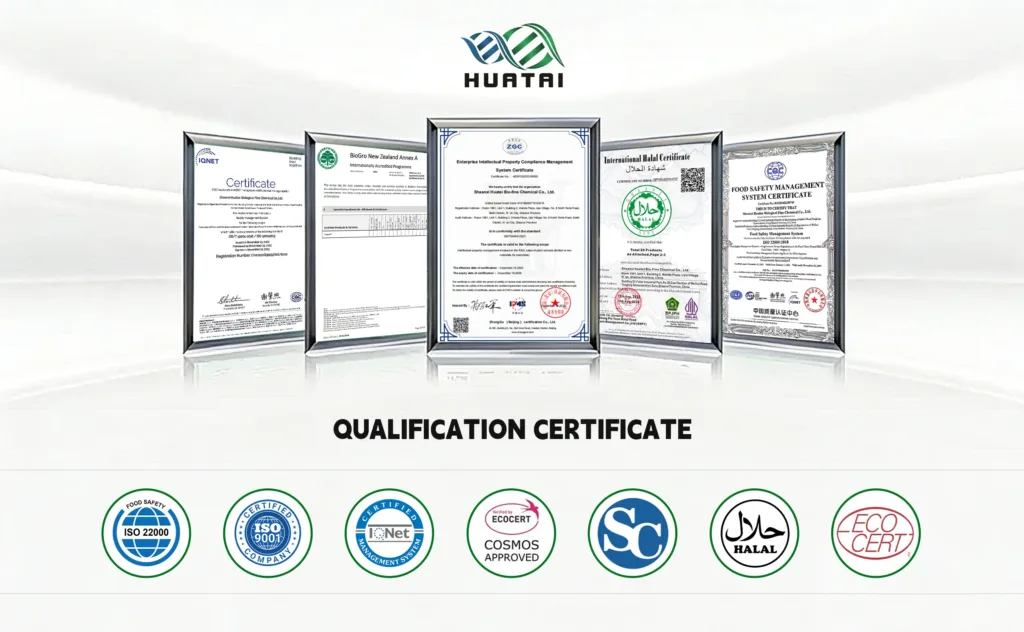
Calidad y credibilidad inquebrantables: Garantizamos que cada lote de nuestros productos cumple con nuestros estándares. Ingredientes activos para el cuidado de la piel Cumple con rigurosos estándares de calidad, incluyendo las certificaciones COSMOS, ISO 9001/22000 y HALAL. Este compromiso, respaldado por un expediente técnico completo, ofrece soluciones con respaldo clínico y garantiza el cumplimiento para cualquier desafío de formulación.

-300x300.jpg)



 English
 German
 Italian
 French
 Spanish
 Japanese
 Korean
 Russian