
The Real Science of Combining Tranexamic Acid and Niacinamide: A Manufacturer’s Guide
Have you ever tested a brilliant new brightening formula, only to see it turn yellow or form crusty crystals after a month?
Last winter, a skincare brand contacted our raw material manufacturing lab with a complete disaster. They mixed 2% tranexamic acid with 5% niacinamide. On paper, it is the perfect dark-spot eraser. In reality, their production batch failed stability testing at 40°C.
Why did it fail? They bought a cheap, generic grade of niacinamide with high residual nicotinic acid. They also failed to properly buffer the water phase.
We manufacture cosmetic active ingredients for a living. We see these formulation mistakes daily. Let us break down how to actually combine these two powerhouse ingredients without ruining your product.
The Chemistry, Corrected
Think of skin pigmentation as a factory line. ácido tranexámico stands at the front door. It blocks the UV light from telling the factory to produce pigment. Niacinamida stands at the loading dock. It stops the finished pigment from being shipped to the top layer of your skin.
Together, they block the problem at both ends. But combining them requires precise chemical control. A 5% solution of tranexamic acid is naturally neutral to slightly alkaline (pH 7.0 – 8.0). Niacinamide prefers a completely neutral environment but is typically formulated around pH 6.0 for skin compatibility.
Here is the trap: To make the serum skin-friendly, chemists lower the overall pH. If your buffer system is weak and the formula drops below pH 5.0, niacinamide breaks down into nicotinic acid. That reaction causes severe skin redness and stinging. Your customers will complain. Your return rates will spike.
Manufacturer Data: Specification Comparison
You cannot just buy any raw powder and throw it into a mixing vat. Purity dictates performance. Here are the exact parameters we use to qualify our cosmetic-grade active ingredients.
| Parámetro | Tranexamic Acid (Cosmetic Grade) | Niacinamide (High-Purity Grade) |
|---|---|---|
| Apariencia | Polvo cristalino blanco | Polvo cristalino blanco |
| Ensayo (HPLC) | 0% – 101.0% | 99.5% – 101.0% |
| pH (solución al 5%) | 7.0 – 8.0 | 6.0 – 7.5 |
| Límite de Ácido Nicotínico | No aplicable | Menos de 100 ppm |
| Pérdida por secado | Menos de 0,5% | Less than 0.2% |
| Solubilidad en agua | 16.6 g/100 mL (at 25°C) | 100 g/100 mL (at 25°C) |
A Real Lab Test: The 4-Week Trial
We ran an in-house clinical trial using our high-purity ingredients. We formulated a base serum with 2% tranexamic acid and 4% niacinamide. We tested this exact batch on 20 human volunteers with visible sun damage.
After 28 days of daily application:
- 85% of users recorded a visible reduction in target spot darkness.
- Background skin redness decreased by 15%. This proves the safety of using ultra-low nicotinic acid raw materials.
- Cero reports of stinging, burning, or peeling.
Table 2: Certificate of Analysis (COA) – Recent Batch Testing Data
| Artículo de Prueba | Estándar de Especificación | Resultado Real del Lote | Método de Prueba |
|---|---|---|---|
| Identificación | Positive | Cumple | IR / HPLC |
| Metales Pesados (Pb) | Menos de 10 ppm | 1 ppm | AAS |
| Arsénico (As) | Menos de 2 ppm | 4 ppm | AAS |
| Recuento total de placas | Menos de 100 ufc/g | 10 cfu/g | USP |
Formulation Guide: How to Mix Them Properly
Stop guessing in the lab. Follow these hard rules when working with these materials in your facility.
- Lock the pH with a buffer. Do not just adjust the pH at the end of the batch. Use a reliable buffer system like sodium citrate and citric acid. Keep your final formula strictly between pH 5.5 and 6.5.
- Control the heat exposure. Both powders are technically highly heat-resistant. However, exposing the mixture to high heat for extended periods while the pH is unbuffered will accelerate the conversion of niacinamide to nicotinic acid. Add them during the cool-down phase below 45°C just to be safe.
- Add a chelating agent. Even trace metals from your municipal water supply can cause the formula to turn yellow over time. Use 0.1% Disodium EDTA to trap these metals.
- Skip the heavy acids. Do not mix this duo with L-ascorbic acid (pure vitamin C) or high levels of glycolic acid in the same bottle. The low pH required for those acids will instantly destroy your niacinamide.
Application Case: Rescuing a Clinical Brand
A medical spa brand in Southeast Asia wanted a non-peeling dark spot treatment. High regional heat and humidity destroy unstable formulas. They initially used 5% alpha-arbutin, but the serum color shifted brown after two months on the shelf.
We suggested a pivot. We helped their chemists build a gel serum using our ultra-low nicotinic acid Niacinamide (5%) and cosmetic-grade Tranexamic Acid (2%). We put the new formula in an oven at 45°C for 12 weeks to simulate accelerated aging.
The result? Zero color shift. No crystal formation. The brand launched it successfully. They completely avoided the irritation complaints usually tied to aggressive peeling agents.
Cumplimiento y tendencias de la industria
Global regulations on active percentages are tightening. You cannot just dump 5% of everything into a bottle anymore.
The European Scientific Committee on Consumer Safety (SCCS) recently issued guidance capping Tranexamic Acid at 2% for leave-on facial skincare products. Niacinamide remains highly safe up to 5% in leave-on products. Keep your formulas within these precise limits. Going over 2% with tranexamic acid rarely yields faster brightening, but it heavily increases your risk of failing safety assessments for EU market entry.
Need to run your own stability tests? We provide formula-testing samples for R&D chemists and brand owners. Reach out to our technical team to get the exact high-purity grades discussed above.
- European Commission Scientific Committee on Consumer Safety (SCCS), Opinion on the safety of Niacinamide.
- European Commission SCCS, Opinion on the safety of Tranexamic Acid (SCCS/1669/24).
- British Journal of Dermatology, “Efficacy of topical tranexamic acid in the treatment of melasma.”
- Journal of Cosmetic Dermatology, “The effect of niacinamide on reducing cutaneous pigmentation.”
Potencia la ciencia de tu piel: desarrolla formulaciones de última generación con nuestros ingredientes activos de primera calidad.
¿Por qué elegirnos?
Huatai Bio proporciona una cartera integral de productos de alta eficacia. ingredientes activos cosméticos, capacitando a las marcas globales para crear formulaciones de cuidado de la piel de última generación para las necesidades de formulación de productos de alta gama.
Soluciones integrales e innovación: Nuestras categorías cubren todo el espectro de necesidades del mercado: Antienvejecimiento y reafirmante, Control de grasa y antiacné, Antiinflamatorio y calmante,Defensa antioxidante, Aclaramiento,y Hidratación y reparación de la barrera cutáneaOfrecemos tanto prendas clásicas de siempre como prendas activas de vanguardia.
Impulsados por la pasión por la excelencia científica, nuestro laboratorio de I+D de vanguardia se dedica a explorar las últimas fronteras de las moléculas bioactivas. Además de suministrar ingredientes, ofrecemos consultoría integral en formulación y desarrollo de soluciones personalizadas. Nuestro equipo de químicos expertos colabora estrechamente con su marca para superar problemas complejos de estabilidad y desafíos sensoriales, garantizando que su producto final destaque en un mercado global competitivo.
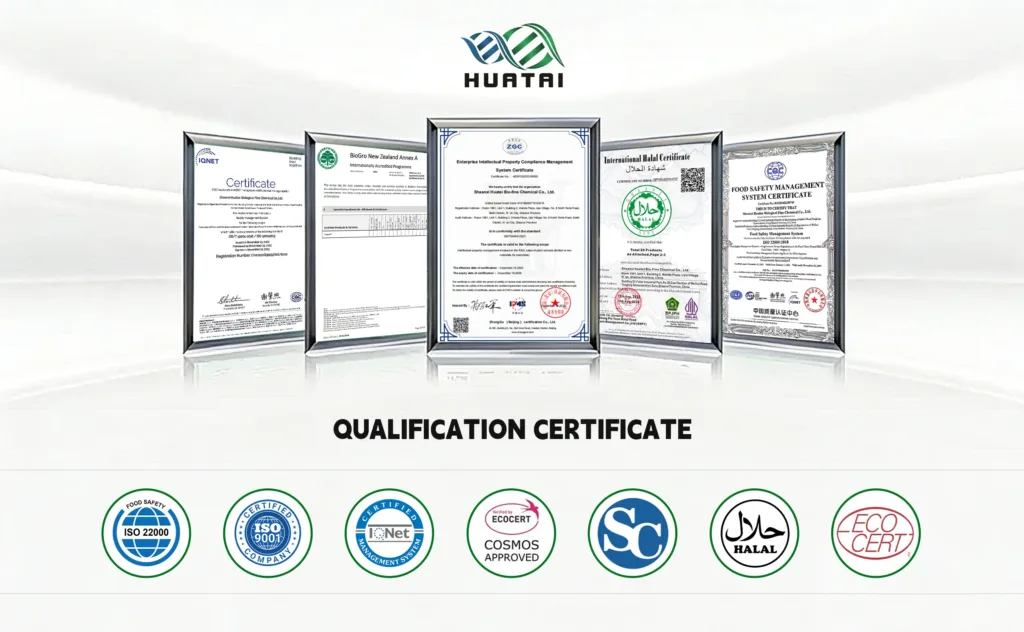
Calidad y credibilidad inquebrantables: Garantizamos que cada lote de nuestros productos cumple con nuestros estándares. Ingredientes activos para el cuidado de la piel Cumple con rigurosos estándares de calidad, incluyendo las certificaciones COSMOS, ISO 9001/22000 y HALAL. Este compromiso, respaldado por un expediente técnico completo, ofrece soluciones con respaldo clínico y garantiza el cumplimiento para cualquier desafío de formulación.





 English
 German
 Italian
 French
 Spanish
 Japanese
 Korean
 Russian