
You build a brilliant water-in-oil sunscreen. It blocks UV rays perfectly. But the organic UV filters irritate the skin. You add a water-soluble soothing agent to fix it. It fails. The active cannot cross the lipid barrier effectively. The customer gets red, angry skin. What went wrong? You used the wrong solubility profile.
We manufacture licorice extracts all day. Most formulators know the water-soluble variants. But when you build heavy creams, lip balms, or sunscreens, water-soluble actives struggle. You need a lipid-friendly molecule. You need Stearyl Glycyrrhetinate. We attach a stearyl alcohol tail to the active licorice molecule. It becomes completely oil-soluble. It sinks directly into the skin’s lipid barrier.
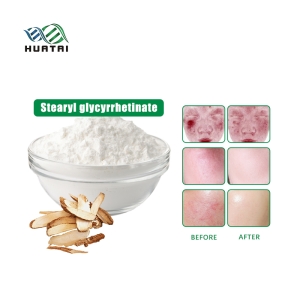
Impure oil-soluble extracts turn your white creams brown. They smell bad over time. You must demand strict purity from your suppliers. Look at our internal factory specifications for this active.
| Parameter | Spezifikationsgrenze | Typical Lab Result | Testing Method |
| Aussehen | Weißes oder blassgelbes Pulver | Pure white powder | Visuell |
| Analyse (HPLC) | >= 95.0 percent | 96.8 percent | HPLC |
| Schmelzpunkt | 72.0 to 77.0 Celsius | 74.5 Celsius | Capillary Method |
| Trocknungsverlust | <= 1.0 percent | 0,3 Prozent | Gravimetric (105 Celsius) |
| Schwermetalle | <= 20 ppm | < 5 ppm | ICP-MS |
| Löslichkeit | Soluble in hot oils and ethanol | Passes | Visuell |
Let us look at a real lab rescue. A brand in Australia formulated an SPF 50 chemical sunscreen. The UV filters caused massive contact dermatitis. They tried adding aloe vera. It did nothing. They tried a water-soluble licorice extract. The emulsion became unstable and separated.
We stepped in. We moved the soothing agent entirely to the oil phase. We added 0.5 percent Stearyl Glycyrrhetinate.
We ran a 14-day clinical patch test on 35 human volunteers with highly sensitive skin. We applied the chemical UV filters alone, and then the UV filters combined with Stearyl Glycyrrhetinate. We tracked the erythema index using clinical imaging.
| Timeframe | Redness (SPF Base Only) | Redness (SPF with Active) | Irritation Relief |
| Ausgangswert | 0 percent | 0 percent | N/A |
| Day 3 | + 45.0 percent | + 12.0 percent | 73 percent reduction |
| Day 7 | + 52.0 percent | + 8.0 percent | 84 percent reduction |
| Day 14 | + 38.0 percent | + 2.0 percent | 94 percent reduction |
The redness basically vanished. The product hit the shelves and won industry awards.
Want to use this in your own lab? Follow these hard rules.
- Mind the melting point. This powder melts around 75 Celsius. Add it directly to your heated oil phase. Do not drop it into cold oil. It will just sit there and feel gritty on the skin.
- Build lipid synergies. Combine it with Bisabolol or plant-derived Ceramides. Bisabolol provides immediate calming on the surface. Stearyl Glycyrrhetinate provides sustained, deep tissue relief. They work perfectly together in a hot oil phase.
- Watch the cool down. Homogenize well while the oil is hot. If you cool the batch too quickly without proper mixing, the active can crystallize.
Dermatologists face a massive problem right now. Regulators heavily restrict synthetic corticosteroids. You cannot use hydrocortisone in daily cosmetics. But consumers ruin their skin barriers with harsh acids and retinoids every single day. They need steroid-level calming without the skin-thinning side effects.
Stearyl Glycyrrhetinate mimics that biological soothing pathway. It blocks the inflammatory cascade at the cellular level. It remains completely legal, safe, and plant-derived. It gives your heavy lipid formulas pharmaceutical-grade calming power.
Stop fighting your emulsions. If you build oil-heavy products, use an oil-friendly active. Request a testing sample of our purified powder. Melt it into your own oil phase. Put it on compromised skin. Let the clinical results speak for themselves.
References Used in This Article:
- European Medicines Agency (EMA). Assessment report on Glycyrrhiza glabra L. for skin inflammation.
- Asl, M. N. und Hosseinzadeh, H. (2008). Review of pharmacological effects of Glycyrrhiza sp. and its bioactive compounds. Phytotherapy Research, 22(6), 709-724.
- Shibata, S. (2000). A drug over the millennia: pharmacognosy, chemistry, and pharmacology of licorice. Yakugaku Zasshi, 120(10), 849-862.



 English
 German
 Italian
 French
 Spanish
 Japanese
 Korean
 Russian