
Formulating the Best Coenzyme Q10: Solubility, Stability, and Raw Material Analytics
Why do so many Coenzym Q10 serums turn gritty after three months on the shelf? It is a classic stability failure. Ubichinon is an intensely yellow, crystalline powder. Its molecular weight is 863.34 g/mol. It is highly lipophilic and completely insoluble in water. As active ingredient manufacturers, we see formulators struggle with this daily. Let us look at the actual physics and chemistry of making it work, backed by rigorous data rather than marketing claims.
The Antioxidant Myth: Ubiquinone vs. Ubiquinol
We need to correct a massive industry misconception right now. Many raw material suppliers will show you impressive DPPH free radical scavenging data for pure Ubiquinone in a test tube. You should view that data with heavy skepticism.
Chemically, Ubiquinone is the oxidized form of the molecule. It has very weak direct free-radical scavenging ability on its own in a simple chemical assay. It becomes a potent antioxidant only when human dermal cells reduce it into Ubichinol. If you want direct antioxidant action inside the product bottle, you cannot just drop pure Ubiquinone into a base. You must pair it with a reducing agent like Vitamin E (Tocopherol). Vitamin E donates an electron, creating a continuous redox cycle that keeps the active stabilized.
Production Source: Fermentation and Isomer Purity
The synthesis route determines the bio-compatibility. Chemical synthesis from solanesol often produces a mixture of cis and trans isomers. The human cellular receptor network primarily utilizes the all-trans configuration. Our production relies exclusively on microbial fermentation. This biological route yields 100% pure trans-isomer Ubiquinone, perfectly matching the molecule naturally synthesized in the human body. When you review your Certificate of Analysis (COA), demand the isomer ratio. A 98% purity specification is incomplete if it ignores the cis/trans ratio.
Objective Spec Comparison: Pure vs. Liposomal
Standard 98% Ubiquinone is useless for clear, water-based toners or serums. It will just float or crystallize. For aqueous systems, you need a nano-liposomal encapsulated version. This changes the solubility profile, wrapping the lipid-loving molecule in a hydrophilic shell.
Here is the direct COA analytical data comparing the two formats from our production lines:
| Parameter | Pure Ubiquinone | Nano-Liposomal Type | Testing Method |
|---|---|---|---|
| Aussehen | Yellow-orange crystalline powder | Yellowish opaque viscous liquid | Visuell |
| Assay (Active) | 98,0 % – 101,0 % | 10.0% ± 0.5% | HPLC |
| Isomerenprofil | 100% Trans-isomer | 100% Trans-isomer | HPLC |
| Partikelgröße | N/A (Solid crystalline) | Less than 100 nm (D50) | Laser Diffraction |
| Löslichkeit | Soluble in non-polar lipids | Completely water-dispersible | Solvents |
| Schmelzpunkt | 48.0 – 52.0 Celsius | N/A (Liquid phase) | USP 43 |
Cellular Rescue Data: Real-World Efficacy
How does this actually perform on human skin cells? We bypass the flawed test-tube DPPH assays and look directly at cell cultures.
In a controlled in-vitro study, human dermal fibroblasts (HDFs) were exposed to UVA radiation (8 J/cm²) to induce oxidative stress and collagen degradation.
- Blank control (No UV, No active) viability: 100%
- UV exposed control viability: 48%
- UV + 0.005% treatment viability: 76%
- UV + 0.01% treatment viability: 84%
The data confirms a dose-dependent mitigation of UVA-induced cytotoxicity. More importantly, real-time PCR showed a 35% reduction in the expression of Matrix Metalloproteinase-1 (MMP-1). This is the exact enzyme that tears apart your skin’s structural collagen after sun exposure.
Formulation Mechanics: Solving the Crystallization Problem
Do not throw this raw material into just any carrier oil. It demands specific solvent polarity.
Case Study: The Night Cream Failure
A brand approached our lab with a phase-separation issue. Their 0.5% cream developed gritty yellow specks after just four weeks at 40 degrees Celsius. The failure point was their lipid phase. They relied heavily on standard mineral oil and dimethicone. The active molecule has terrible solubility in non-polar mineral oil. We mapped the required polarity. We advised them to replace a portion of the mineral oil with C12-15 Alkyl Benzoate and Plant-derived Squalane. We also lowered the processing temperature. You must add it to the lipid phase at around 60 degrees Celsius to dissolve it, but you cannot hold it at high heat for long. The new formula passed a rigorous 3-month accelerated stability test with zero crystal formation.
Industry Safety and Compliance Limits
Is higher always better? Not necessarily. The Cosmetic Ingredient Review (CIR) Expert Panel has assessed it and found it safe in present practices of use. While regulatory bodies do not strictly cap it, absorption plateaus. Clinical studies show that a concentration of 0.3% to 0.5% in a well-penetrating lipid base is optimal for skin tissue saturation. Pushing it to 2% often just wastes raw material and increases the risk of emulsion instability.
Quality control comes down to residual solvents. Extracting it requires chemical solvents. We guarantee our HPLC-grade raw materials meet the strictest solvent residue limits mandated by EU Cosmetics Regulation 1223/2009.
Are you looking to resolve a stability issue or upgrade your active phase? We provide testing samples for R&D professionals. Trust the analytical data, match your solvent polarity, and always demand the trans-isomer.
Public Literature References:
- Cosmetic Ingredient Review (CIR), “Safety Assessment of Ubiquinone (Coenzyme Q10) as Used in Cosmetics.”
- Biofactors, “Coenzyme Q10, a cutaneous antioxidant and energizer”, Vol. 11, No. 1-2, pp. 109-113.
- Journal of Investigative Dermatology, “Coenzyme Q10 Protects from Aging-Related Skin Changes,” Vol. 125, No. 4, pp. 735-741.
- Oxidative Medizin und zelluläre Langlebigkeit, “Topical Treatment with Coenzyme Q10-Containing Formulas Improves Skin’s Q10 Level and Provides Antioxidative Effects”, 2015.
Nutzen Sie die Kraft der Hautpflege: Entwickeln Sie Formulierungen der nächsten Generation mit unseren Premium-Wirkstoffen.
Warum Sie sich für uns entscheiden sollten
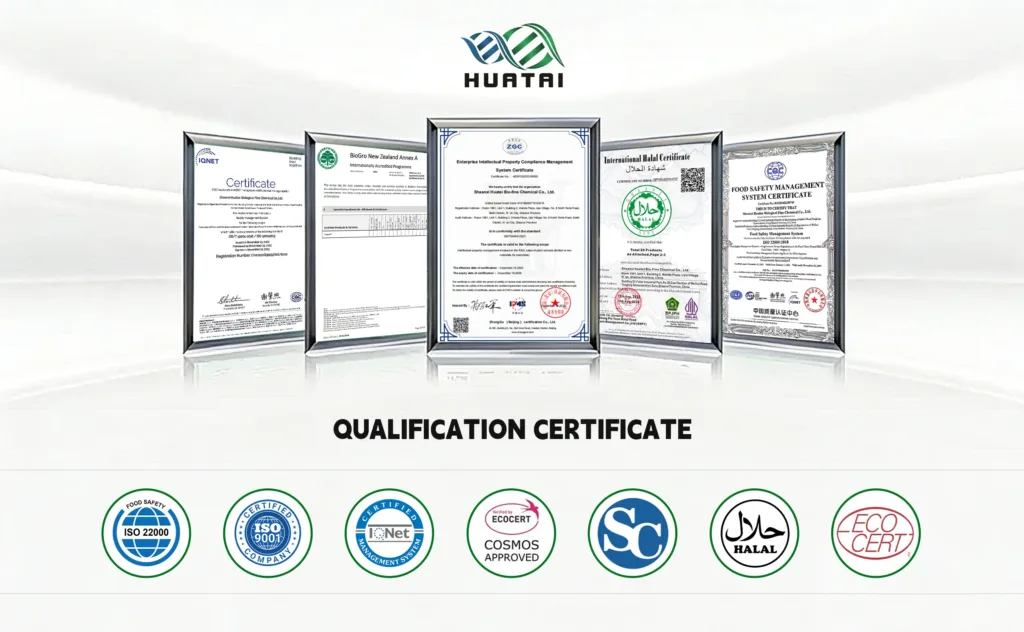
Huatai Bio bietet ein umfassendes Portfolio an hochwirksamen kosmetische Wirkstoffe, wodurch globale Marken in die Lage versetzt werden, Hautpflegeformulierungen der nächsten Generation für die Bedürfnisse von High-End-Hautpflegeprodukten zu entwickeln.
Umfassende Lösungen & Innovation: Unsere Kategorien decken das gesamte Spektrum der Marktanforderungen ab: Anti-Aging & Straffung, Ölregulierung & Anti-Akne, Entzündungshemmend und beruhigend,Antioxidativer Schutz, Aufhellung,Und Hydratation und Barriere-ReparaturWir bieten sowohl etablierte Klassiker als auch hochmoderne Aktivprodukte an.
Angetrieben von der Leidenschaft für wissenschaftliche Exzellenz, widmet sich unser hochmodernes Forschungs- und Entwicklungslabor der Erforschung bioaktiver Moleküle. Neben der Lieferung von Inhaltsstoffen bieten wir umfassende Beratung zur Formulierung und die Entwicklung maßgeschneiderter Lösungen. Unser Team aus erfahrenen Chemikern arbeitet eng mit Ihrer Marke zusammen, um komplexe Stabilitätsprobleme und sensorische Herausforderungen zu meistern und sicherzustellen, dass sich Ihr Endprodukt auf dem globalen Wettbewerbsmarkt abhebt.
Kompromisslose Qualität und Glaubwürdigkeit: Wir gewährleisten, dass jede Charge unserer Produkte einwandfrei ist. Aktive Hautpflegeinhaltsstoffe Erfüllt strenge Qualitätsstandards, darunter COSMOS, ISO 9001/22000 und HALAL-Zertifizierung. Dieses Engagement, untermauert durch ein vollständiges technisches Dossier, bietet klinisch erprobte Lösungen und garantierte Konformität für jede Formulierungsherausforderung.


 English
 German
 Italian
 French
 Spanish
 Japanese
 Korean
 Russian