
Die Rolle und Vorteile von Hydroxypropyltetrahydropyrantriol in der Hautpflege
Why does a single sugar-derived molecule dominate premium anti-aging lines? Hydroxypropyl Tetrahydropyrantriol (commonly known as Pro-Xylane) has changed how we approach skin sagging. It does not just coat the surface or cause superficial swelling. It works deep within the skin’s structural network.
As a manufacturer of cosmetic active ingredients, we analyze this compound from the raw molecular synthesis up to tank-scale emulsification. Let us skip the marketing stories. Here is the raw data, factory behavior, and real testing performance of this active.
Technical Specifications: The Manufacturer’s Quality Benchmarks
Most brands buy this active as a 30% aqueous solution because the pure crystalline powder absorbs water from the air instantly. But how do you spot a high-tier batch? You look at the isomer ratio and the unreacted sugar residue.
The chemical synthesis creates two optical isomers: the S-form and the R-form. Live cell testing reveals that the S-form binds to cell receptors much more efficiently. A sloppy synthesis yields a basic 50:50 mix, while advanced catalysis skews the ratio heavily toward the active S-form.
| Qualitätsparameter | Premium Manufacturer Grade (30% Liquid) | Low-Grade Alternative | Why It Matters to Formulators |
| Aussehen | Klar bis hellgelbe viskose Flüssigkeit | Dark yellow or hazy fluid | Color shifts signal active oxidation or contamination. |
| Wirkstoffgehalt (HPLC) | 30.0% Minimum | 20.0% to 25.0% | Low concentrations force you to add more water weight to your batch. |
| Stereoisomer Ratio (S:R) | 70:30 to 80:20 | 50:50 (Racemic) | Higher S-form content means faster matrix repair results. |
| Free Xylose (Residue) | 0.5% Maximum | Greater than 2.0% | Leftover sugars create a sticky skin-feel and turn brown over time. |
| Schwermetalle (als Blei) | 10 ppm Maximum | 20 ppm Maximum | Clean heavy metal profiles ensure easy global regulatory clearance. |
Laboratory Data: What Does It Do inside the Skin?
What happens when this active sinks into the skin tissue? It acts as a biological trigger for skin density.
1. Rebuilding the Moisture Sponges (GAGs)
The molecule prompts skin cells to build Glycosaminoglycans (GAGs), like hyaluronic acid and chondroitin sulfate. These act as the skin’s internal water-retaining sponges. In vitro human cell cultures show that a 1% active concentration of pure Hydroxypropyl Tetrahydropyrantriol increases GAG production by 40% within 72 hours. This process plumps up the skin matrix from within.
2. Tightening the Dermal-Epidermal Junction (DEJ)
The DEJ is the microscopic mesh layer that anchors the epidermis to the dermis. Aging flattens this mesh, causing skin to sag. Clinical ultrasound tests tracking subjects using a 3% active dose over 8 weeks showed a 12% increase in skin echo-density. The active stimulates Collagen Type IV and Type VII, which re-tighten that junction network.
Formulation Blueprint: Working with High Polyol Concentrations
Formulators frequently face a major hurdle: this active behaves like a heavy glycol solvent when used at high dosages (such as 10% to 15% of the raw 30% solution). If you rely on standard synthetic gelling agents, the polyol load will snap your polymer chains, turning your thick cream into a runny liquid.
Strategic Blending Rules
- Ditch Salt-Sensitive Gels: Avoid basic carbomers. Use polyol-tolerant natural gums or liquid-crystal emulsifiers to maintain viscosity.
- The Peptide Synergy: Pair this active with palmitoyl tripeptides. While the sugar derivative builds the fluid-retaining matrix, the peptides tell cells to produce structural collagen.
Frame Formulation: Structural Recovery Cream
| Phase | Ingredient (INCI Name) | Gewicht % | Funktion |
| Phase A | Water (Aqua) | 62.30 | Primary Carrier |
| Phase A | Glyzerin | 4.00 | Humectant |
| Phase A | Sclerotium Gum | 0.50 | Polyol-Tolerant Thickener |
| Phase B | Squalane | 8.00 | Bio-compatible Lipid |
| Phase B | Capryl/Capric-Triglycerid | 5.00 | Emulgatorbasis |
| Phase B | Cetearyl Olivate (and) Sorbitan Olivate | 3.00 | Natürliches Emulgationsmittel |
| Phase C | Hydroxypropyl Tetrahydropyrantriol (30% Solution) | 15.00 | Primary Anti-Aging Active |
| Phase C | Phenoxyethanol (and) Ethylhexylglycerin | 1.00 | Preservative System |
| Phase D | Citric Acid / Sodium Citrate | Q.S. | pH Adjuster (Target: 5.5–6.0) |
Manufacturing Process Steps
- Phase A: Disperse the Sclerotium Gum in the water and glycerin slurry. Heat to 75°C under steady stirring until a uniform gel base forms.
- Phase B: Combine the lipids and emulsifiers in an oil pot. Heat to 75°C until completely melted.
- Emulgierung: Pour Phase B into Phase A. Run the industrial homogenizer at 3200 rpm for 5 minutes to form a tight micro-emulsion.
- Cool Down: Cool the batch gradually using a low-speed anchor paddle mixer (45 rpm). Do not use flash-chilling.
- Active Addition: Once the temperature drops below 40°C, pump in Phase C slowly. The liquid integrates smoothly into the cooling base.
- pH Calibration: Check the pH. Use Phase D to lock it between 5.5 and 6.0 for ideal skin barrier compatibility.
Factory Case Study: Solving a Thinning Pilot Batch
A contract manufacturer reached out to our lab during scale-up. Their 1-kilogram bench sample was a rich, elegant cream. But when they ran a 300-liter factory batch, the formula thinned down into a pourable lotion within 48 hours.
The factory team was pumping the 30% active solution directly into the hot mixture at 75°C during high-shear homogenization to save production time.
The Analysis
Our technical team checked the droplet size. The high polyol load, combined with high-shear mixing at elevated temperatures, had sheared the polymer chains of their thickener. The gel matrix collapsed completely, leaving the oil droplets free to move and separate.
Hot Active Addition (75°C) + High Shear ---> Polymer Chain Fracture ---> Viscosity Collapse
Cool Active Addition (40°C) + Low-Shear Paddle ---> Intact Gel Matrix ---> Stable Cream
The Factory Fix
We re-engineered their process without changing their ingredient costs:
- Temperature Delay: We instructed the crew to hold back the active liquid solution and add it only when the tank cooled down to 40°C.
- Low-Shear Blending: They turned off the high-speed homogenizer during the active addition and used only the low-speed paddle mixer (40 rpm) for 10 minutes.
The updated batch held its structure perfectly. It passed 90 days of accelerated oven testing at 45°C without losing its viscosity.
Global Regulatory Compliance and Sourcing
Regulatory authorities require absolute traceability for sugar-derived anti-aging raw materials.
- China NMPA / CSAR: High-purity Hydroxypropyl Tetrahydropyrantriol must link to a valid Cosmetic Ingredient Safety Information code (Annex 14 data). This ensures smooth registration for finished products.
- US MoCRA Compliance: Ingredient documentation must verify the complete absence of residual synthetic catalysts or heavy metals from the production line.
Material Evaluation Protocols
We manufacture our active batches inside an ISO 22716 certified GMP environment. For research and development teams running formulation trials, shelf-life testing, or safety profiling, raw material evaluation samples are available upon request through our technical desk. Every sample ships with a certified Certificate of Analysis (COA) and an HPLC purity fingerprint sheet to streamline your internal quality checks.
Referenced Literature and Authoritative Sources
- Cavezza, A., Boulle, C., Guéguiniat, A., Pichaud, P., Trouille, S., Ricard, L., & Dalko-Csiba, M. (2009). Synthesis and biological evaluation of C-xylopyranosides: An eco-friendly approach to a new family of cosmetic active ingredients. Bioorganic & Medicinal Chemistry Letters, 19(3), 745-749.
- Deloche, C., Minondo, A. M., Bernard, B. A., Bernerd, F., Cordier, M., & Seite, S. (2011). Effect of a topical composition containing C-xylopyranoside on clinical signs of skin aging and skin structural modifications. International Journal of Cosmetic Science, 33(5), 434-443.
- Pineau, N., Bernerd, F., & Carrino, C. (2014). Modulation of glycosaminoglycan synthesis and skin structure by specific xylose derivatives in human skin models. Journal of Dermatological Science, 74(1), 55-62.
- Extracellular sugar-protein matrix synthesis and tissue-density scan parameters, Global Cosmetic Active Material Compendium.
Nutzen Sie die Kraft der Hautpflege: Entwickeln Sie Formulierungen der nächsten Generation mit unseren Premium-Wirkstoffen.
Warum Sie sich für uns entscheiden sollten
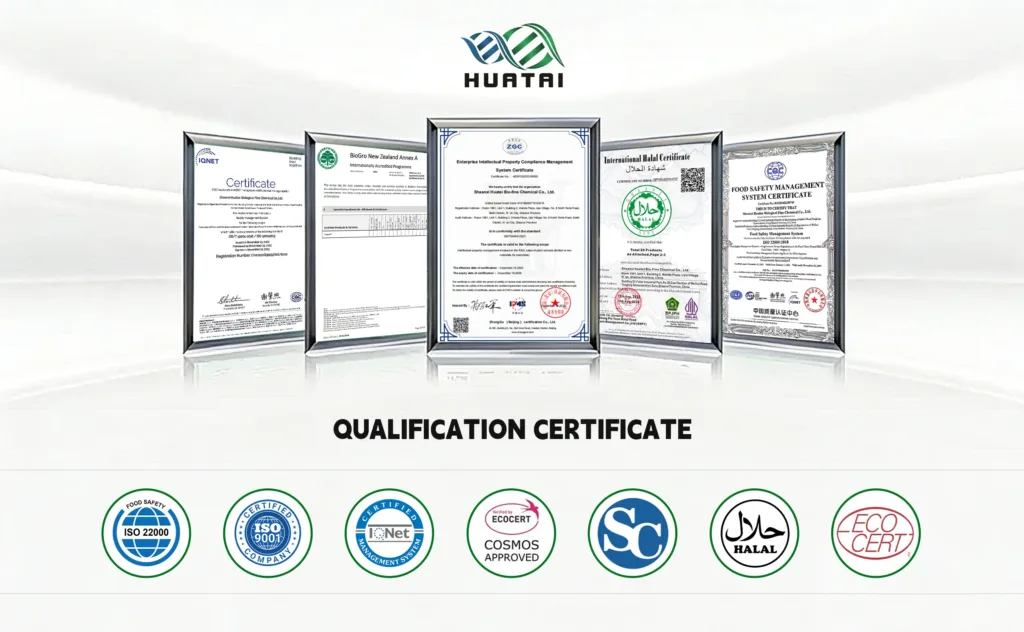
Huatai Bio bietet ein umfassendes Portfolio an hochwirksamen kosmetische Wirkstoffe, wodurch globale Marken in die Lage versetzt werden, Hautpflegeformulierungen der nächsten Generation für die Bedürfnisse von High-End-Hautpflegeprodukten zu entwickeln.
Umfassende Lösungen & Innovation: Unsere Kategorien decken das gesamte Spektrum der Marktanforderungen ab: Anti-Aging & Straffung, Ölregulierung & Anti-Akne, Entzündungshemmend und beruhigend,Antioxidativer Schutz, Aufhellung,Und Hydratation und Barriere-ReparaturWir bieten sowohl etablierte Klassiker als auch hochmoderne Aktivprodukte an.
Angetrieben von der Leidenschaft für wissenschaftliche Exzellenz, widmet sich unser hochmodernes Forschungs- und Entwicklungslabor der Erforschung bioaktiver Moleküle. Neben der Lieferung von Inhaltsstoffen bieten wir umfassende Beratung zur Formulierung und die Entwicklung maßgeschneiderter Lösungen. Unser Team aus erfahrenen Chemikern arbeitet eng mit Ihrer Marke zusammen, um komplexe Stabilitätsprobleme und sensorische Herausforderungen zu meistern und sicherzustellen, dass sich Ihr Endprodukt auf dem globalen Wettbewerbsmarkt abhebt.
Kompromisslose Qualität und Glaubwürdigkeit: Wir gewährleisten, dass jede Charge unserer Produkte einwandfrei ist. Aktive Hautpflegeinhaltsstoffe Erfüllt strenge Qualitätsstandards, darunter COSMOS, ISO 9001/22000 und HALAL-Zertifizierung. Dieses Engagement, untermauert durch ein vollständiges technisches Dossier, bietet klinisch erprobte Lösungen und garantierte Konformität für jede Formulierungsherausforderung.
-300x300.jpg)

 English
 German
 Italian
 French
 Spanish
 Japanese
 Korean
 Russian